Forces can change the shape of objects - including parts of bridges!
![[diagram]](arcf.gif)
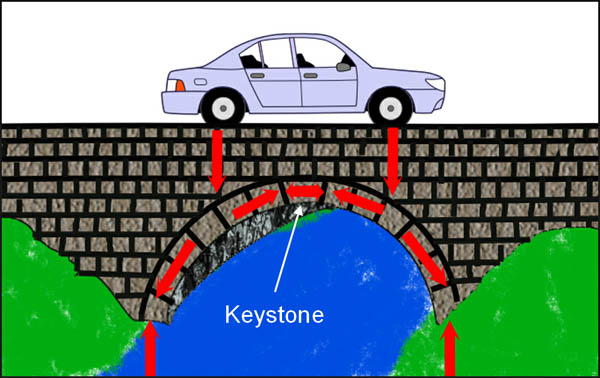
The load on the bridge causes only forces of compression (squashing) through the bridge. The key stone pushes sideways, in both directions, so that forces are transmitted to the foundations of the bridge, at both sides. Modern arch bridges are more likely to be built from concrete, than stone, but the forces in an arch behave in a similar way, whatever the material.
![[diagram]](beaf.gif)
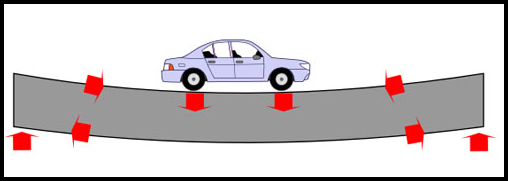
The forces of gravity, acting downwards on objects on the bridge (the load), and the reaction in the bridge supports, change the shape of the bridge. The beam bends in the middle. This squashes (compresses), the top surface of the beam. At the same time the bottom surface is stretched (in tension).
Because most of the forces act on the top and bottom surfaces, beam bridges are often built with more material at these surfaces than the middle. Steel girders used will be shaped like this:
![[diagram]](t.gif)
So long as the forces stay balanced, the bridge will support the load. The bridge will fail if the forces within it become too great. Some building materials, such as concrete, can stand very high squashing (compression) forces, but not stretching (tension) forces. Other materials are better in tension than compression.
![[diagram]](susf.gif)
The force of gravity acting on the load is transmitted through tension in the cables to the piers, and to the anchorage at either bank.
The very long spans, which are possible with this type of bridge mean that it is more likely sideways forces will act on it. High winds, or vibrations caused by movement of traffic can also cause twisting.
Forces of compression squeeze an object: Compression make objects buckle, as shown in the diagram, or it can make them crumble.
Forces of Tension pull on an object: Tension can make an object become longer and thinner, as shown in the diagram, or it can make it snap.